Saturday, January 30, 2021

Sunset hunters

Sun(set) on Saturn

The day was coming to an end. In about two minutes most of the sky would turn to black. There was so much time to observe the sunset. The sight was fantastic. Looking down from the high position the clouds below were glowing in shades of gray and yellow. One great swiveling cyclone formed in the clouds, but it was high enough that the sound of winds was subdued. In the distance the star - our sun - was shining with rather cold light. It appeared minuscule and was hastily sinking below the horizon. The whole right half of the sky was filled with unnaturally regular elliptic white strip, looking like an edge of a giant porcelan saucer, freshly taken from the pottery wheel. The saucer was ornamented with two black, sharp and perfectly elliptical lines, which extended throughout the whole sky. The sunset ended rapidly, but the giant saucer remained illuminated for another hour. It was a sunset on Saturn.

***

No human ever witnessed the sunset on Saturn. It was the spacecraft Voyager 2 that recorded the sunset and sent photographs to Earth. Sunsets on Saturn nevertheless happen. They happen all the time, and as Saturn's day is only 11 hours long, they are more frequent then Earth's sunsets. There is no reason not to enjoy the sunset on Saturn. If Voyager can do it, we can do it too. So, next time when the sky in your place on Earth gets covered and you are unable to see the sun, just transport yourself (mentally, if not otherwise) 1280 million kilometers in the direction of Saturn and enjoy the spectacular view.  After all, as they say "it's all in the head", isn't it?


Wednesday, January 20, 2021

We humans are social beings

This is a sentence that gets on my nerves. Being a cynic, I am annoyed by empty rants, and this sentence is repeated over and over again without any added value. My new year's promise however was to become less cynical and kinder person - though solely because of my health, not because of any special philanthropy. Therefore, I will deal with the above statement now, before I become so kind that - God forbid - it starts to makesense to me. I don't know anything about sociality, but that's no problem, since a complete outsider can become an expert in any field after only a few hours browsing the internet. So let me start with some surfed theory.

The theory of self-determination defines three basic psychological needs: (1) autonomy is the need to have our own interests guiding our behavior; (2) competence is the need to find appropriate challenges and to make progress; (3) connection is the need to connect with others, to belong and to be emotionally secure. The need for relationships with others is interpreted in three ways: (3a) the need for affiliation (to feel love and acceptance from social groups); (3b) social exchange (in relationships we look for a tangible or intangible rewards and we are willing to invest something for it); (3c) a sense of self (our emotions and beliefs are built on past relationships). Life forms that work well together are more viable and able to continue their genes. Strong social ties are associated with longer life, and social
isolation with poorer health, depression and the risk of a shorter life. 

This is the theoretical framework of the thesis about social beings. It only shows the positive side of the medal, the negative side is obviously less emphasized, though I have to admit that I didn't make a special effort to find it - I'll add it myself.

In resolving life's dilemmas, my favorite method is to look to animals (or plants, stones) after clarification. Some animals are social: ants, bees, corals, a herd of wolves; others are antisocial: spiders, mantises, bears, snakes, eagles. Some types of sociality are more emphasized as others. Social insects e.g. have specialized castes that complement and even genetically differentiate, and on the other hand a lone wolf might just survive alone.Plants are mostly antisocial, and stones too. Viruses (and bacteria) are antisocial, although they come in huge numbers. Life forms are thus so diverse that the evolutionary trend toward the social behavior is not evident. Living beings are always social at least in reproduction, although this can also be done in a non-social way, e.g. as impersonal release of sperm into the environment in case of corals, shellfish or plants.

Sociality in the broader sense can be understood as any relationship between individuals, such as in feeding. Therefore, we can say that we are social even when we sit alone at a table and eat a steak or a soy polpet. Feeding is otherwise a conflicting relationship because the individual who is the food dies in the process. In general, the conflicting relationships are in majority: for example, in the series 7 worlds - 1 planet I counted 89% of conflicting relations between animals (48% fighting for food, 19% for territory, 15% for partners and 7% for gene continuation) and 11% non-conflicting (7% care for young and 4% interspecific symbiosis). Sociality is supposed to help overcoming stress, but paradoxically, most of the stress stems from conflicting social relationships. Sociality is therefore both a problem and a solution. That everything is not rosy in social world turned out during the covid-19 pandemic. People were forced into sociality in their own homes, and that, in addition to depression, led also to increased violence, including murder.

The extreme notion of sociality, however, could be this: everything in nature is social because everything is interconnected. A hydrogen atom could be asocial because it has only one electron, but already a helium atom has 2 electrons and is hence social. But even hydrogen has one proton, so it also socially cooperates with its electron. Don't let this seem absurd to you: something like that is announced in this link. But if the whole universe is social, then sociality is not a noteworthy property at all because it is all-encompassing. Clearly, the sentence about sociality in the title does not aim so universally, but rather it only speaks of the fact that people cannot survive without social contacts of "higher order". The higher order of contacts is understood as "soft", emotional contacts that are not directly related to material survival such as food or reproduction. Emphasizing sociality also implicitly hints at superiority of the social species on the evolutionary scale. That is just another expression of the narcissism and self-praise so characteristic of the human race. On the other hand, the definition of sociality could be "dependence", i.e. that the individual cannot survive alone. In this sense, sociality is a handicap, shortcoming and therefore inferiority. In nature, of course, there is neither evaluation nor morality, but if we have to judge, then from the point of evolution the most valuable species is the one that survives the longest. But this cannot be the human species, if for nothing other, then because of a small, awkward detail: in our gut there are billions of bacteria that will live for at least a few hours after the last human dies.

Wednesday, September 23, 2020

The ROT project - Root Of Time

Visual evidence of the past 11 and a half years.

"Distinction between past, present and future is only a stubbornly persistent illusion" wrote Albert Einstein just a month before he died.  Not a surprising statement for the author of the relativity theory. Even if that was just a consolation of a man who felt that his life is coming to
an end.

The concept of time definitely deserves a thorough treatment, and I will hopefully dig in it in some future post of this blog. For now I will just agree that time is thus only an illusion, but the progression from the past to the future (and not vice-versa) is really hard to dismiss. Can we have a simple and clear visual evidence of the past? If I take an empty plank at the start and put a nail in it at regular time intervals, then the accumulation of the nails on the plank can be such an evidence.

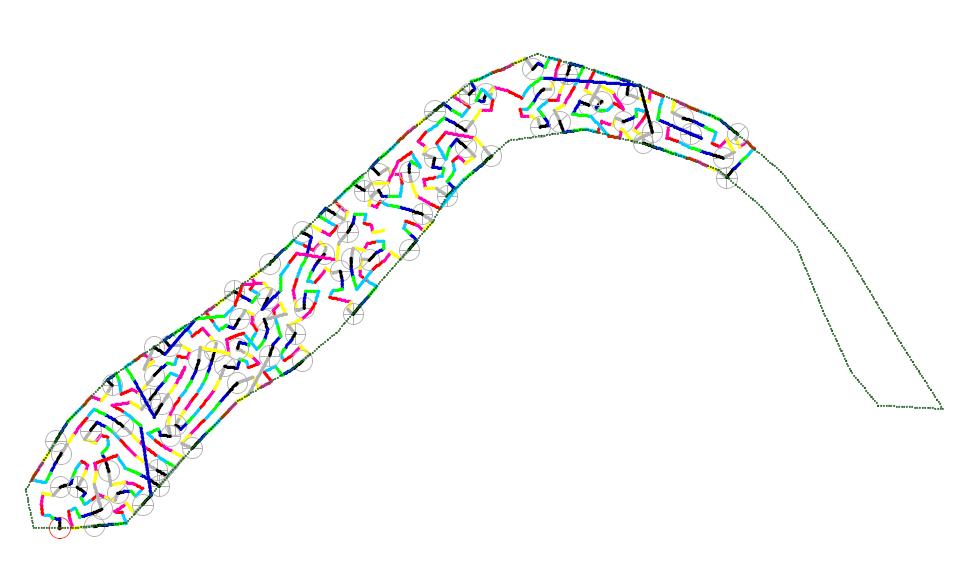
Instead of the plank I took a tree root. For the time interval I chose a week. Every Sunday I would put a nail (more likely a screw) in it. The root is big enough for 784 screws, 784 weeks, 5488 days or 15 years. That is the estimated time of the rest of my life - based on life expectancy for men of my age. Screws in the root should form a path, so that past can be traced back to every individual moment (week). To make this path more traceable, I should
paint the heads of the screws sequentially with eight colors: black, dark blue, green, light blue, red, violet, yellow and gray. Alternatively, instead of painting the screws' heads I could draw a path between points on the root colored with eight colors. In that case I would not need screws at all. But screws add a bit of dramatic and solid sense.

Before actually starting this lifelong project, I made a computer simulation. On the plane model of the root I generated a mesh of quadrilaterals with approximately 784 nodes. I chose a starting node for the first screw (at the bottom left) and then simulated the path (should I say the time?) so that the next screw was in the next closest node. Both versions (colored heads and colored path) are shown in the pictures and both look quite nice.

I put the first screw in the root on Sunday, 2.8.2020. The head of this screw is not colored, to distinct it from all other screws. 

Today, 21.9.2020, I have seven screws in the root and, interestingly, the proportion of their  area to the area of the whole root somehow indicates the time left to my death. I therefore could not claim that I was caught unprepared.

The root.

Plane model of the root with quadrilateral elements and nodes.

Simulated path for 600 weeks - version with colored screws heads.

Simulated path for 600 weeks - version with colored continuant path.


Tuesday, June 30, 2020

Minimalistic cooking recipes

Dumplings with baked paprika.
I-B:Dough,D:Soft Cheese. P-Wrap. M-Boil,15'. P-Remove. I-V:Paprika. P-Add.  


There's been an explosion of cooking activities in the media in the last years. Culinary gurus from various backgrounds are emerging from every nook and cranny and fascinate us with their unique masterpieces. Cooking product resembles more a work of art then edible food, requires mind-blowing number of pots, pans and procedures to create it and almost a novel to explain how to do it.

There is a permanent oscillation between specification and generalization in human history, and while it might be nice to have a recipe for reindeer's spleen sautee from North Tungusia with all its details, I suspect that cooking is not a rocket science and can be reduced to few basic tasks.

After all, no matter how artistic your food looks on the plate, it will blend already in your mouth, will hit your stomach as a paste, and there will be no difference whether it was cooked in a Michelin 3-star restaurant or it came from a tube which they use on a space station.

My minimalist cooking follows few basic principles: (a) food should be prepared in only one dish (possibly temporarily removing (P-Remove) or adding (P-Add) some ingredients between the cooking dish and the serving plate); (b) recipes include ingredients (I-), procedures (P-) and heat media (M-) which are organized into few basic groups; (c) recipes could be generalized so that some or all of the ingredients may be replaced with some other; (d) recipes are written in a short, symbolized form in a line or two and should be read at a glance.

This approach should be clear from the following one-page cue-sheet. It starts with a table that explains the formulation of ingredients, procedures, heat treatment and tasks (tasks are applied sequently, but optionally skipping or repeating some of them; brackets ([]) indicate an optional part). The cue-sheet includes 19 general and 14 specific recipes in a form of colored tasks.  In this generalized form it can be used as a quick reference or as an incentive to invent new recipes by (randomly) choosing different ingredients and tasks.


However, I realized that this might be too cryptic for many of you and a sample explanation is needed. So, how the first general recipe for Steak + vegs: 
"I-A,P-Whol,M-ContP-RemI-V,M-OilP-AddI-C
translates into ordinary language? It means: I-A: take an ingredient from Animal group (a steak); P-Whol: dont' cut it; M-Cont: put it in the cooking pot on heated surface (without any oil) and fry it; P-Rem: remove it to from a cooking pot to a plate; I-V,M-Oil: cut and put vegetables in a cooking pot and fry them on oil; P-Add: add a steak from the plate to the cooking pot; I-C: add condiments to the pot.

Happy minimalist cooking!

  
Pots and plates: 
1-iron pot for induction. 2-aluminium wok for gas.  3-stainless steel pot for gas, for bigger quantities of food. 4-dish for electrical oven. 5-plate for microwave oven, for eating and as a temporary depository during cooking.

And some pictures of  my minimalist cooking products.

Dumplings with baked paprika (cooked in wok).
I-B:Dough,D:Soft Cheese. P-Wrap. M-Boil,15'. P-Remove. I-V:Paprika. P-Add.  


Eggs with mushrooms (cooked in wok, on gas) 
I-V:Onio,Mushr, M-Oil. P-Remov. I-A:Egg, M-Oil. P-Add. I-C:Coriander. 


Stuffed paprika (cooked in pot no.3, on gas);
I-A:Mince,V:Oni,B;Rice, M-Oil,10'. I-V:Paprika, P-Fill.
I-S;TomPas,Oil,Wat,C;SP. M-Steam,35'. I-C:Coriander.


Baked Sea Bream with vegetables (cooked in pot no.4, in oven);
I-A:SeaBream, P-Whole, I-V:Paprika,Tomat,Garlic,C:Oil,LemonJuic.
M-Air,200C,12', I-V:Lemon.


Wednesday, May 27, 2020

Coronavirus epidemic predictions

WTF has Coronavirus to do with MiniBe? Did I "mak-a a mistak-a"? No, Coronavirus is perfectly suitable for the introductory post in this blog abut minimal way of living. Virus' size is about 1 micrometer. It has reduced its structure down to the basics, the pure parasitic DNK, to the border line between living and non-living things. It can't get more minimal than this! Yet, this minimal, mindless thing manages to almost crush the civilization of the most glorious species in the evolution of life (by its own proclamation, though). Which makes you wonder if "purpose" or "intelligence" really matter. So let the virus be the star of the opening post of this blog.

I simulated the epidemics by a simple model, which I will discribe here in short. During the epidemic the virus spreads in the population P. At a certain time there are four non-overlapping groups of people in the population. N are the people who haven't been affected by the virus, but are susceptible to infection. C are the contagious: people infected by the virus who can spread the disease to susceptible. D are those who were infected and died. R are those who were infected, recovered and became immune (i.e. are not susceptible). We also define a group A=C+D+R, i.e. people affected by the virus in any way. The groups are related by: P=N+C+D+R=N+A. Epidemic ends when C=0.

The basic parameters of the epidemic are the contagiousness c, mortality m and survival s. The virus spreads in a day i by new infections ΔAi from the group C according to the rules:


ΔAi=Ci-1 c ,  ΔDi=ΔAi m,  ΔRi=ΔAi s

Epidemic data in the world population on day 27 may 2020 and projection for two future months is shown on the following figure. According to this prediction the epidemic will last till the end of July and will cause about 555000 deaths.
Covid-19 epidemic in  the world; real data up to 27-May-2020 and projection.